IEEE
TRANSACTIONS ON VISUALIZATION AND COMPUTER GRAPHICS
1071-2626/95$04.00 © 1995 IEEE
Vol. 1, No. 1: March
1995, pp. 5-15
Real Time Responsive Animation with
Personality
*
Ken Perlin
Abstract![[mdash]](rtrap_files/mdash.gif) Building on principles from our prior
work on procedural texture synthesis, we are able to create remarkably
lifelike, responsively animated characters in real time. Rhythmic and
stochastic noise functions are used to define time varying parameters that
drive computer generated puppets. Because we are conveying just the "texture"
of motion, we are able to avoid computation of dynamics and constraint
solvers.
Building on principles from our prior
work on procedural texture synthesis, we are able to create remarkably
lifelike, responsively animated characters in real time. Rhythmic and
stochastic noise functions are used to define time varying parameters that
drive computer generated puppets. Because we are conveying just the "texture"
of motion, we are able to avoid computation of dynamics and constraint
solvers.
The subjective impression of dynamics
and other subtle influences on motion can be conveyed with great visual
realism by properly tuned expressions containing pseudo-random noise
functions. For example, we can make a character appear to be dynamically
balancing herself, to appear nervous, or to be gesturing in a particular way.
Each move has an internal rhythm, and
transitions between moves are temporally constrained so that "impossible"
transitions are precluded. For example, if while the character is walking we
specify a dance turn, the character will always step into the turn onto the
correct weight-bearing foot. An operator can make a character perform a
properly connected sequence of actions, while conveying particular moods and
attitudes, merely by pushing buttons at a high level.
Potential uses of such high level
"textural" approaches to computer graphic simulation include role playing
games, simulated conferences, "clip animation," graphical front ends for MUDs
[15], [6], and synthetic performances.
Index TermsControlled randomization, dance, forward
kinematics, gesture, procedural synthesis, real time animation, simulation of
body language.
I. INTRODUCTION
A. Description of the Problem In previous
work [10] we used pseudo-random functions to
create natural surface textures of surprisingly realistic appearance without
having to model the underlying physics. This was done with a set of
interactive tools, consisting of:
- a powerful interactive prototyping language,
- a good set of signal generation and modification functions,
- a good controllable noise primitive, and
- a set of conventions for fitting things together.
In the recent work described in this
paper we have applied this approach to the problem of building real time
graphic puppets that appear to be emotionally responsive.
We choose the word "puppets" very
deliberately here. This work is not artificial intelligencethese animated characters do not encode
any real intentionality; they only encode a visual impression of personality.
This work was first presented in [11]. We will refer to the "dancer"
figure from that animation in our examples.
B. Related Work Simulated actors that
embody true physical constraints are being developed by Badler et al. at the
University of Pennsylvania [2]. Dynamic balancing walking robots
have been developed by Raibert [12], and animal and human figure
simulations based on inverse dynamics have been developed by Girard and
Maciejewski [7].
Using layered construction in the
design of articulated movement has been explored by Chadwick et al. [4]. Similarly, layered control
structures for walking robots (subsumption architectures) have been used
effectively by Brooks [3].
Morawetz and Calvert have added a sense
of personality to simulated human movements by supporting secondary movements
[9]. In a radically different approach,
genetic algorithms have been seen to induce movement that gives an intriguing
impression of personality in goal directed mutations of articulated figures
[14].
C. Guiding Principles We adopt the
following general approach: program individual motions into the puppets
beforehand, but also ensure that transitions between any pair of actions are
visually correct.
A potential objection to this approach
is that things might look repetitious. But by using randomization we can
easily build actions that are very controllable yet never actually repeat
themselves.
In addition to the forward kinematics
of individual actions, we build in only three simple constraints. Characters
never walk through walls, they never spin their heads all the way around
backwards, and they maintain fixed foot contact with the floor when doing
"walking" actions.
D. Comparison With Dynamics Approaches
This approach has advantages as well as disadvantages when compared with more
ambitious approaches that try to model the underlying physics. One advantage
is that it allows much more direct control over the subtle movements that
convey the appearance of emotional expressiveness. Another is that
computational costs are far lower.
A disadvantage is that the model can't
teach itself new actions. If the puppet's foot is snagged by a rock while
walking, the puppet cannot properly perform the particular movement of
tripping and recovering its balance, unless we've already taught it how to do
that.
The two approaches are compatible.
Ideally a system would employ both predetermined movements, as well as
physical laws that allow it to deal with unexpected events in its environment,
such as the sorts of dynamic balancing of the 'Jack' figure from Badler's
group at the University of Pennsylvania.
II. METHOD
A. Actions, Weights, Transitions The two
major components of our method are actions and weights. An
action is some simple or repetitive movement, such as walking or
standing, or a pirouette turn. The relative contribution of an action is given
by a weight, which is always a scalar value between 0.0 and 1.0.
We cause the puppet to respond to her
environment in real time mainly by changing these various weights. For
example, decreasing the weight for one action, while simultaneously increasing
the weight for another, causes a transition in behavior from the first action
to the second (Fig. 1).
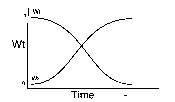
Fig. 1.
Note that if this is done properly, the
actions can be connected together seamlessly in arbitrary sequences, like
characters in a string of text, to build up complex behaviors (Fig. 2). In spirit this is similar to
the summation of B-spline knot functions to construct smooth piecewise-cubic
curves.
.gif)
Fig. 2.
If these transitions are applied
naively, the results can be disastrous. An example would be a transition from
an action in which our puppet is stepping onto her left foot to an action in
which she is stepping onto her right foot. Another example would be a
transition that would make the puppet's arm interpenetrate her body on its way
from the first action to the second action.
We solve this problem by controlling
the times of transitions between actions, and by designing actions in such a
way that it is possible to control their transitions.
In this section we will describe the
structure of our system, proceeding in a bottom up fashion. We start with
joint kinematics, go on to explain how coherent actions are developed, and
then to the scalar controls that combine those actions. The bottom to top
structure of our system is as follows:
- joint kinematics
- individual actions
- scalar weights to blend actions
- synchronizing actions
- discrete choice controls
- layers of choice controls
- constraints
B. Bottom Level Kinematic Hierarchy
Nineteen universal joints are used in our current approximation of the human
figure: one each for waist, neck, and head, plus four for each limb (Fig. 3). Ideally there should be more;
this was the minimum that seemed necessary to allow emotional
expressiveness.
.gif)
Fig. 3. Nineteen universal joints.
Separate joints appear at the base and
top of the neck. The first universal "arm" joint is actually at the chest.
This controls the position of the shoulder. The arm structure involves the
following universal joints: chest, shoulder, elbow, and wrist. Similarly, a
leg has: pelvis, hip, knee, and ankle joints.
Each universal joint allows three
rotations: x, then z (the two "aiming" parameters), followed by y (rotation
around the limb axis). Any angle not specified defaults to a "zero" position
where the puppet is standing upright with arms at her side.
Here is the actual code of the main
routine for positioning and drawing the body, executed once per frame, as
expressed in our modeling language's reverse polish notation:
  Push
    Neck joint
    Nod joint draw_head

    Push
        Lchest         joint
        Lshoulder      joint
        Lelbow         joint
        Lwrist         joint draw_arm

        -1,1,1 scale
        Rchest         joint
        Rshoulder      joint
        Relbow         joint
        Rwrist         joint draw_arm
    Pop
    Waist draw_torso
    Push
        Lpelvis        joint
        Lhip           joint
        Lknee          joint
        Lankle         joint draw_leg

        -1,1,1 scale
        Rpelvis        joint
        Rhip           joint
        Rknee          joint
        Rankle         joint draw_leg
    Pop
  Pop
Push and Pop manipulate a local matrix
stack, as in the Silicon Graphics GL model [13]. Waist, Neck, Nod, Lchest, etc.,
are joint variables, and draw_head, draw_arm, draw_torso, draw_leg are
procedures to draw parts of the body. Note the scaling by -1 in the x
dimension to draw the right arm and leg as mirrors of the left arm and leg.
The variables Waist, Neck, Nod, etc.,
represent the 19 universal joints of the figure. Each is a vector of length
three. The values in these vectors, which change at every frame, drive the
figure's joints. They are set by actions and by transitions between actions.
The actual work is done in
subprocedures draw_head, draw_torso, draw_arm and draw_leg. Each of these
routines does successive forward kinematic transformations on the current
matrix in order to compute locations for the puppet's component parts.
C. Actions A primitive action is
constructed by varying the puppet's scalar joint angles over time t
via expressions of raised sine and cosine, as well as noise, where "raised
sine" and "raised cosine" are defined by  and
and .xbm) .
.
At each frame we compute raised sine
and cosine, as a function of time, at two frequencies one octave apart:
  s1 := rsin(time)
  c1 := rcos(time)
  s2 := rsin(2*time)
  c2 := rcos(2*time)
The variables s1 and
c1 are used together within actions to impart elliptical rotations.
Variables s2 and c2 do the same at double frequency.
Together the expressions s1,
c1, (1 - s1), and (1 - c1) collectively generate a
four phase periodic signal. In practice we have not found any need for finer
phase control of periodic actions than this quarter cycle accuracy.
We also provide a set of independent
coherent noise sources n1, n2, ...:
  n1 := .5 * (1 + noise(t))
  n2 := .5 * (1 + noise(t + 100))
  n3 := .5 * (1 + noise(t + 200))
The coherent noise source is defined as
in [10]. Here the noise is simpler, since
it need only be defined over a one dimensional temporal domain, rather than
over a three dimensional spatial domain. The algorithm we use is:
- 1) if x is an integer, noise(x) = 0.
- 2) define a mapping G(i) from the integers to a fixed
set of pseudorandom gradients.
- 3) given any i < x < i + 1, do a
hermite spline interpolation, using the two neighboring gradients
G(i) and G(i+1).
The only tricky step above is 2). To
implement this step efficiently, we precompute a table of pseudorandom
gradients g[0..255]. Then for any integer i we return
g[imod 256]. A comprehensive discussion
of noise implementations can be found in [5].
Every action is built by using some
combination of the above source signals in simple expressions, to control the
rotation of some joints within some range. Each joint is at its zero position
when the puppet is standing at attention with both arms at the side. An action
is specified by a table of ranges and time dependent behavior for each joint
that this action affects.
The stylized way in which these are
coded makes it simpler to provide high level descriptions of rhythmic motions.
Here is the code we use to specify a "rhumba" dance (Fig. 4):
{
 { 5 5 5 }   {-5 -5 -5} {n1 n2 n3} Nod
 {15 0 5 }   {-15 0 -5} {c1 0 s1}  Rchest
 { 0 0 0}    {0 0 0}   {s1 0 s1} Rshoulder
 {-90 0 0}   {-70 0 0}  {s1 0 s1}  Relbow
 { 0 0 0 }   {0 0 0}    {s1 0 s1}  Rpelvis
 {-25 -15 5} {0 0 -10}  {s1 s1 s1} Rhip
 { 50 0 0}   {0 0 0}    {s1 0 s1}  Rknee
 { 0 0 0}    {0 0 0}    {s1 0 s1}  Rankle
 { 0 0 10}   {0 0 -10}  {s1 0 s1}  Waist
 {-15 0 -5}  {15 0 5}   {c1 0 s1}  Lchest
 { 0 0 0}    {0 0 0}   {s1 0 s1} Lshoulder
 {-70 0 0}   {-90 0 0}  {s1 0 s1}  Lelbow
 { 0 0 0}    {0 0 0}    {s1 0 s1}  Lpelvis
 {0 0 -20} {-10 -25 20} {s1 s1 s1} Lhip
 { 0 0 0}    {20 0 0}   {s1 0 s1}  Lknee
 { 0 0 0}    {0 0 0}    {s1 0 s1}  Lankle
 } 'rhumba define_action
.gif)
Fig. 4. Four phases of a rhumba.
Each line of the above code specifies
an assignment of three items to a particular joint (Nod, Rchest, etc.). Each
of these items contains three numeric values. Each of the first two items is
run immediately and packaged up as a vector, representing an extreme position
of motion for the joint. The third item is evaluated at every frame where the
action is performed, and is used as a linear interpolant between the two
extremes.
Let us take the second line as an
example. It specifies motion for the "Rchest" joint, the universal joint which
pivots around the chest to displace the right shoulder. For this joint, the
limits of rotation about the x axis are -15 degrees to 15 degrees. Similarly,
the y axis is fixed at 0 degrees, and the z axis varies from 5 degrees to -5
degrees.
The time varying behavior for this
joint is as follows. The x axis interpolates between its limits as c1
= rcos(time) and the z axis interpolates between its limits
as s1 = rsin(time). The y axis stays fixed.
The action defined above is a
relatively stylized dance step, so most of its motion is rhythmic, controlled
by periodic functions. Only the head motion has a little randomness, which in
this case gives the impression that the puppet is looking around while she
dances.
Notice also that the joints at the
chest are driven by c1 in their x axis and by s1 in
their z axis. This gives an elliptical motion to the shoulders, which
is crucial for giving the subtly "Latin" feel of this dance move.
In contrast, here is the definition for
standing in a casual pose (Fig. 5):
{
 { 0 15 0} {0 -15 0} {0 n1 0}  Neck
 {20 0 0 } {       } {      }  Nod
 { 0 0 -5} {       } {      }  Lchest
 { 0 0 0 } {       } {      }  Rchest
 {-10 0 0} {       } {      }  Lshoulder
 {-10 0 0} {       } {      }  Rshoulder
 {0 0 -10} {       } {      }  Lelbow
 {0 0 -10}   { 0 0 -5} {0 0 n1}  Relbow
 { 0 0 5 }   {       } {      }  Waist
 {-2 0 2 }   {2 0 -2}  {n1 0 n1} Lpelvis
 {-2 0 -2}   { 2 0 2}  {n1 0 n1} Rpelvis
 {0 0 -14}   {      }  {      }  Lhip
 {-10 25 12} {      }  {      }  Rhip
 {-5 0 0 }   {      }  {      }  Lknee
 {25 0 0 }   {      }  {      }  Rknee
} 'stand define_action
.gif)
Fig. 5. Standing
Here most of the vectors are left
blank. This means that these joints are completely static for this action. All
of the motion of this action is driven by noisethere is no rhythmic motion at all. The noise
gives the effect of subtle restlessness and weight shifting. The motion is
subtle, but if it is left out, the puppet looks stiff and unrealistic.
For some actions, we put small
additional expressions in the third, time dependent, vector in order to couple
actions between the joints, or to modify the bias or gain of a joint [10]. For example, here is the
specification of a running action. For clarity of exposition, we have assigned
the four phase signals to variables A, B, C, and
D, respectively. We have also assigned double speed oscillation and
its complement to variables A2 and B2, respectively.
{
 c1     => A
 s1     => B
 1 A -  => C
 1 B -  => D
 c2     => A2
 1 A2 - => B2
 {0 -15 0}    {5 15 0}  { A2 C 0}  Waist
 {0 -90 0}    {0 90 0}  { 0 N 0}  Head
 {0 -10 -5}   {0 10 5}  { 0 C D}  Rchest
 {0 0 0}     {45 0 0}   { D 0 0} Rshoulder
 {-120 0 -10} {0 0 0}   { C 0 B2}  Relbow
 {-10 0 0}    {10 0 0}  { C 0 0}  Rwrist
 {0 -10 -5}   {0 10 5}  { 0 A B}  Lchest
 {0 0 0}      {45 0 0}  {B 0 0}  Lshoulder
 {-120 0 -10} {0 0 0}   {A 0 B2}  Lelbow
 {-10 0 0}    {10 0 0}  { A 0 0}  Lwrist
 {0 -10 0}    {0 10 0}  { 0 A 0}  Rpelvis
 {-40 0 0}   {40 0 0} {A B.3 * - 0 0} Rhip
 {0 0 0}   {130 0 0} {B .2 bias 0 0} Rknee
 {-45 0 0} {45 0 0} {C .7 bias 0 0} Rankle
 {0 -10 0}    {0 10 0}  { 0 C 0}  Lpelvis
 {-40 0 0}  {40 0 0} {C D .3 * - 0 0} Lhip
 {0 0 0}  {130 0 0} {D .2 bias 0 0} Lknee
 {-45 0 0} {45 0 0} {A .7 bias 0 0} Lankle
} 'running define_action
This action consists entirely of
rhythmic motion, except for the head's "looking around" movements, which are
driven by coherent noise. The double speed oscillations serve to slightly bend
and unbend the waist twice per cycle, as weight is alternately borne either by
one foot or by two feet. Double speed oscillations are also used to rotate
slightly about the elbow's y axis. This rotation pulls the forearms a
bit closer to the body twice per cycle, both when in front and when behind the
body.
Note the use of the bias function in
the rotations about the knee joints. These give the non-weight bearing knee a
little extra kick at the time it swings forward. For the same reason, we add a
small amount of rotation to each hip, 90 degrees out of phase with its primary
motion.
Once an action is designed, this sort
of structure provides many opportunities for customization. In the above
example, we can replace each of the constants in the knee and hip "bias"
expressions by variables. As we modify these variables we obtain walks that
reflect different emotive states and degrees of energy.
D. Combining Multiple Weighted Actions To
combine actions we assign numerical weights to every potential action in the
action mix. These weights give the relative contribution of each action to the
total motion of the puppet. The weights vary over time; at any given moment,
only a few actions have a non-zero weight. For each joint, the contributions
from all the actions to that joint's position are combined via a convex sum (a
weighted sum in which the weights add to unity). We do this as follows.
Assume there are k actions
with associated weights w1, w2, ...,
wk, and that there are n universal
joints in the entire body, where each joint involves three rotational degrees
of freedom [x, y, z]. Any one of the k
actions will use only some subset of these n joints. Let
Ci be a vector whose values are 1 for each joint
j used by action i, and 0 otherwise.
Let Ai =
[V1, V2, ...,
Vn] be a vector representing the value
[x, y, z] that is generated by action i
for every universal joint j. We obtain the position of universal
joint j via:
.xbm)
In the next sections we describe the
way in which we coordinate the variation over time of the weights of different
actions.
E. Synchronizing Actions The phases of all
the actions are synchronized. For example, when a dancer puppet is walking,
and we ask her to do a classical fondue turn to the right, she won't begin the
turn until she is about to put her weight down on her right foot (Fig. 6). This is the only sensible
thing to do, since one must begin a fondue turn by stepping into it. This
requires that both the walk and the fondue turn be built from expressions that
run off the same master clock.
We handle transitions between two
actions that we wish to have different tempos via a morphing approach: At the
start of the transition, we use the tempo of the first action; at the end, we
use the tempo of the second action. During the time of the transition, we
continuously vary the speed of the master clock from the first to the second
tempo. In this way, the phases of the two actions are always aligned during
transitions.
We may also define new actions as
extended transitions between two or more other actions. For example, we may
morph between the "running" example above and a "standing at attention" pose,
in which all joint angles are fixed at zero. When the interpolant is in the
range 0.3 to 0.5, this interpolated action becomes a visually realistic walk
(to the author's surprise). But a human walking tempo is also 0.3 to 0.5 that
of a human running tempo. For this reason, we use the morph transition
parameter to modulate the tempo. In this way a puppet can be made to
continually and realistically transition from standing still, through walking,
to running, or to anywhere in between.
In a scene with multiple puppets (see
Section IV below) each puppet maintains its own individual tempo.
F. Dependencies Between Weights Let's say
that the puppet is walking, and we decide to have her do a pirouette. It would
make no sense for her to continue walking while she is pirouetting. The
mechanism we employ is to build dependencies between weights.
.gif)
Fig. 6. Transition into a fondue turn.
The pirouette weight acts as an
inhibitoras its value
rises from zero to one, it drives down the effect of the weight that controls
such steady state actions as walking. Then as the pirouette weight drops down
to zero again, the walking weight is allowed to take effect again.
The numerical value of the walking
weight is not itself modified. But anything that depends upon it is seen
through the filter of the pirouette weight. Conceptually, the pirouette weight
"blocks" the walking weight, much as the alpha channel of a foreground image
blocks a background image during a compositing operation (Fig. 7).
Note that an action need not involve
all joints. Examples include such actions as waving with the left arm,
shrugging the shoulders, or scratching one's head. If an action which involves
only a subset of the joints blocks another action, then it will only block
those joints included in this subset. So we may use this structure to "layer"
partial actions. For example, a puppet that is running can be told to wave his
hand, without breaking his stride.
A small section in the program creates
a layering structure for such dependencies. This control is divided into two
levelsstates
and weights. The state level consists entirely of discrete boolean
values. For example, either the puppet "wants" to walk, or she does not. The
weight level consists of continuous values between zero and one. These are
derived by integrating the effect over time of the discrete states (Fig. 8). These continuous weights are
what go into the convex sum above, to drive the puppet. Some of these weights
are dependent on others.
For example, if a user directs the
puppet to walk, then the discrete walk state turns on, and the continuous
weight controlling the walking action gradually rises from zero to one. If the
user subsequently directs the puppet to perform a pirouette, the weight of the
pirouette action gradually rises to one. The discrete walk state continues to
stay on, but the continuous weight of the walk is driven down to zero by its
dependency on the weight of the pirouette action. When the pirouette state is
disabled, the weight of the pirouette action gradually falls to zero, and the
walking action at the joints gradually reappears.
The dependencies between weights are
implemented by a sequence of conditional expressions. This approach is similar
in spirit to Brooks' subsumption architecture [3] for walking robots, in which more
immediate goals (eg: "don't fall over) block out longer term goals (eg: "walk
to the edge of the table).
G. Transition Times Each user specified
action starts the rise of some scalar weight from zero to one, via an S-shaped
ramp. We have found that the only tuning needed for controlling the shape of
any given transition is a single scalar value that specifies the duration of
the transition from zero up to one or back down again. This is specified in
seconds, not framesbehavior should not change with frame rate! In
order to effect this, we use the actual system clock, not a frame counter, to
time transitions. We also use the system clock to drive the signal sources
described above in Section II.C.
.gif)
Fig. 7.
Some transitions look better when they
are fast, and others look better when slow. It is surprising how much
expressiveness one can achieve by tuning these transition times. For example,
when the dancer puppet performs the action "put hands on hips indignantly and
look at the camera, she puts her hands on her hips first, and only then, a
beat later, does she turn to look at the viewer (Fig. 9). Then when she goes from this
state into the slow dance, she continues to look at the viewer for a second or
so, even while she's already dancing and her body is turning away.
We conjecture that this behavior looks
correct because fixing one's gaze on another person is a more explicit
emotional signifier than is changing one's bodily activity, and therefore
should happen more slowly. In this case, even when she is beginning to dance
we still want the dancer to convey the reminder that she was annoyed at us
just a moment ago.
We believe that the use of different
transition times for various parts of a gesture is a very powerful means for
conveying subtle impressions of intention. Although our approach to this is
currently ad hoc, we hope that experimentation of this kind can lead to a set
of useful rules for understanding of human body language. Related work in the
role of emotion and communication in gesture is found in the chapter by Calvin
and Morevic in [1].
.gif)
Fig. 8.
H. Non-Hierarchical Motions The puppet
will always conform to certain simple constraints no matter what the forward
kinematics specify. Here are the key constraints:
- the foot on the ground propels the puppet
- the supporting foot must be at floor level
- obstacles are avoided by turning away from them
- the head won't turn all the way around backwards.
Each of these constraints is imposed by
a few lines within the code that models the body. For example, to propel the
puppet from the foot we detect the lowest foot. We measure how far this foot
has moved since the previous frame. We then add this to a cumulative
displacement, and apply a positional offset to the rendered body equal to the
opposite of this displacement. The effect is that the lower foot always stays
in place and propels the body.
Also, whenever we compute each new
total foot position, we average in half of the previous total just for the
y (vertical) component. The effect of this is to always keep the
supporting foot level with the ground.
Object avoidance is done as follows.
Each wall emits a repulsive force vector, which increases near the wall. We
sum all of these vectors. If the puppet walks into such a vector field, and is
angled off to the left (or right) of facing the wall, then we give her a
tendency to turn more to the left (or right). When this is tuned properly, she
just avoids walls, and so we don't have to worry about collisions. In the more
general case, we would put a similar repulsive vector field around any object
we want her to avoid, as well as an attractor field at each open doorway. This
would act as a variety of remote compliance to help her find her way in.
We can make the puppet "look at the
camera, just by turning her neck joint. Actually she can look at any aim point
in the scene. But this is not desirable when the puppet's body is facing
directly opposite from this direction. To avoid complete backward head turns,
we add a constraint into the neck turning joint. A dot product of the body's
forward position and the desired aim direction is calculated. As the value of
this dot product drops from 1.0 down to -1.0, we continually lessen the factor
by which we influence the head to turn in the aim direction. We found through
trial and error that we get the most natural results when this factor reaches
zero at a dot product value of -0.6.
The visual effect is that as the puppet
turns away from us, she holds our gaze for a bit, and then gradually ignores
us as she continues to turn further away. Then as she continues turning, she
eventually locks her gaze with us again on the other side, by turning her head
over her other shoulder (Fig. 10).
The above constraints constitute all of
the "physics" built into the model, other than the natural constraints imposed
by the forward kinematics itself (i.e., that the limbs never fly apart).
I. Shifting Body Parts In order to achieve
real-time performance, it is important to limit the elaboration of puppet
geometry (see the next section). Yet we do not wish to sacrifice the
appearance of human form. To attain a natural appearance without using large
numbers of body parts, we shift body parts around as joints flex, in order to
keep the visual appearance of human form for all body angles.
For example, the thigh consists of
three intersecting ellipsoids, one for the main thigh mass, a second for the
muscle in back of the thigh, and a third for the muscle high up and inside the
thigh. When the puppet bends the thigh very far backward about the hip (such
as in a fondue turn (Fig. 6)) the two front ellipsoids have
a tendency to separate from the puppet's pelvis. We compensate as follows. As
the hip joint bends backwards, we slide these ellipsoids down the
thigh (away from the hip) in linear proportion to the degree of bending (Fig. 11). We provide similar sliding
mechanisms at all body parts where such compensation is needed.
.gif)
Fig. 9.
.gif)
Fig. 10.
.gif)
Fig. 11.
J. User Interaction User interaction is
quite simple. The user only needs to control the discrete states of the
puppet. Currently this is handled by a panel of buttons (Fig. 12). All continuous behavior is
automatically derived by the system through integration over time, as
previously described.
.gif)
Fig. 12.
III. IMPLEMENTATION
In our current instantiation, all parts
are rendered as polygonal mesh approximations of 50 ellipsoids. The simulation
has been run on an SGI Indigo Elan (at 7.5 frames/sec) or an Indigo 2 (at 15
frames/sec), and calls the SGI GL library for rendering.
It also runs efficiently on any Unix or
486-based Linux machine, but for this instantiation the figure can be rendered
only in silhouette. In this case rendering is done by computing the silhouette
ellipse for each ellipsoid and then doing a software scan conversion (Fig. 13). Since this is a silhouette
rendering, front-to-back ordering does not need to be taken into account.
Using this method, the dancer runs at six frames per second on a 486/DX66
processor.
.gif)
Fig. 13.
The button panel is implemented via a
small stand-alone tcl/tk program. Communication with the this program is done
through a two-way ASCII pipe.
IV. ONGOING AND FUTURE WORK
We are looking at the combination of
these procedural techniques with motion capture. The research question here is
how to analyze motion capture of walk cycles or gestures in order to convert
them into a form compatible with the procedural synthesis techniques. Our
approach is to align the natural cycles of walks and other rhythmic motions so
that they can be blended together.
We also are beginning to study group
interactions between these simulated puppets. This research is focused on
situations in which people communicate richly through body language, such as
parties, bar scenes, and meetings.
Because all control of a puppet's state
is discrete, knowledge of actions and transitions between two or more
interacting puppets can be done by exchanging state tokens. If a character
knows the state of another character, then for non-contact pairwise
interactions it suffices to know only the position and facing direction of the
other character. This method of communication is fast and compact, and scales
up gracefully in simulations with large numbers of puppets.
Using this approach, we make the
characters "press each other's buttons." For example, when two characters are
engaged in conversation, they tend not to simultaneously talk at once
(although they occasionally do), and they also tend to avoid long collective
silences. When a third character walks up the behavior of the other two
shifts, depending upon the status of the newcomer and how each of the other
two feels about him/her.
A related notion that we will explore
is peripheral attention. For example, suppose a man and a woman are engaged in
conversation, and another man appears in the line of vision of the first. How
would one show the fact that the effect of the woman's attention involuntarily
drifting toward the other man, even though her intention is to maintain the
conversation? Similarly, how would one show the shift in each man's attitude
when the woman's behavior is noticed? The first man might begin to talk more
frequently; the second might drift toward the conversation.
In recent work, we have developed
methods of running these group simulations on multiprocessors and across
multiple networked computers. This is done over a network of Unix workstations
as follows. Each actor is a separate program which communicates through its
standard input and standard output. A supervisory rendering process opens up a
two way read/write pipe to each actor. Each actor may be invoked via a remote
shell, so that it need not be on the same workstation as the renderer. To send
messages, actors print commands to their standard output which are parsed and
executed at each frame by the supervisor program. If one actor wants to send a
message to another, then it prints a wrapper command. This wrapper command
instructs the supervisor program to print a message command string to the
standard input of the recipient actor. The recipient then parses and executes
this message.
This approach makes it quite easy to
allow different kinds of actors to each respond in the most appropriate way to
a given message. The Camera is an actor which possesses behavior like any
other. For example, in our current system Actor1 can send the messages:
{my_location "look_here"} "Camera"  send_message

{my_location "look_here"} "Actor2"  send_message
where my_location is the current x, y,
z position of Actor1. Note that different recipients are free to
interpret any message as they see fit. For example, the Camera actor generally
averages all "look_here" requests, so that it keeps all attention seeking
actors in its range of vision. In contrast, if several "look_here" requests
are sent to a human actor, it will generally honor only one of them. As a
result, an actor will adjust his/her gaze to track only the message sender of
greatest interest. This provides a simple object-oriented message capability,
with overloading of methods based on the type of the recipient.
In addition, we are exploring immersive
interactions using projector screens and position sensors, so that real people
can interact with these characters, which are digitally composited into
miniature models of interior spaces. Within this experimental laboratory we
explore questions of how to convey peripheral awareness, approach/avoidance,
"paying attention," "listening," etc. This is in the spirit of the recent
Alive project of Maes, et al. at MIT [8]. We are particularly interested in
immersive scenarios involving two or more projection screens, in order to see
to what extent simulated body language will help to convey the impression of
various competing social or attention getting activities.
We are also studying the semantics of
the discrete state transitions that visually represent shifts in attitude and
attention. We are particularly interested in determining to what extent can we
encode merely the rhythm of interpersonal interaction, in order to convey the
impression of social complexity. For example, could entire narratives be
structured in this manner?
V. CONCLUSIONS
Using ideas from procedural texture
synthesis, we are able to create remarkably lifelike, responsively animated
characters in real time. By conveying just the "texture" of motion, we are
able to avoid computation intensive dynamics and constraint solvers. We
believe these techniques have the potential to have a large impact on computer
role playing games, simulated conferences, "clip animation," graphical front
ends for MUDs, and synthetic performances.
ACKNOWLEDGMENTS
I would like to thank Athomas Goldberg
for production support on this paper, and in particular for the illustrations,
as well as on the work itself. I would also like to thank Cynthia Allen, David
Bacon, Troy Downing, Mehmet Karaul, Tom Laskawy, Kuochen Lin, Jon Meyer, and
Jack Schwartz for all their help and encouragement. Ben Bederson, Bruce
Naylor, and Silicon Graphics Inc. have provided hardware assistance for this
research. Thanks as well to Marcelo Zuffo, Roseli Lopez, and the folks down at
the University of Sao Paulo for all their support. And muito obrigado
to Emi, who inspires the dance.
* Ken Perlin is with the Media Research
Laboratory, Department of Computer Science, New York University, 715 Broadway,
New York, NY 10003; e-mail: perlin@nyu.edu
IEEECS Log Number V95002.
REFERENCES
[1] N.I. Badler, B.A. Barsky, and D.
Zeltzer, Making Them Move: Mechanics, Control, and Animation of
Articulated Figures, San Mateo, Calif.: Morgan Kaufmann Publishers, 1991.
[2] N.I. Badler, C. Phillips, and B.L.
Webber, Simulating Humans: Computer Graphics, Animation, and Control,
Oxford Univ. Press, 1993.
[3] R. Brooks, "A
robust layered control system for a mobile robot," IEEE J. of
Robotics and Automation, vol. 2, no. 1, pp. 14-23, 1986.
[4] J.E. Chadwick, D.R. Haumann, and
R.E. Parent, "Layered construction for deformable animated
characters," Computer Graphics (SIGGRAPH '89 Proceedings),
vol. 23, no. 3, pp. 243-252, 1989.
[5] D. Ebert et al., Texturing and
Modeling, A Procedural Approach, London, England: Academic Press, 1994.
[6] D. Gerlernter, Mirror
Worlds, Oxford Univ. Press, 1992.
[7] M. Girard and A.A. Maciejewski,
"Computational modeling for the computer animation of legged
figures," Computer Graphics (SIGGRAPH '85 Proceedings), vol.
20, no. 3, pp. 263-270, 1985.
[8] P. Maes et al., "The MIT ALIVE Project," Computer Graphics (SIGGRAPH '93
Proceedings), 1993.
[9] C.L. Morawetz and T.W. Calvert,
"Goal-directed human animation of multiple movements,"
Proc. Graphics Interface, pp. 60-67, 1990.
[10] K. Perlin, "An
image synthesizer," Computer Graphics (SIGGRAPH '85
Proceedings), vol. 19, no. 3, pp. 287-293, 1985.
[11] K. Perlin, "Danse Interactif," Computer Graphics (SIGGRAPH '94
Proceedings), vol. 28, no. 3, 1994.
[12] M. Raibert et al., Legged
Robots That Balance, MIT Press, 1986.
[13] SGI,
SGI Programmers Manual, Mountain View, Calif.: Silicon Graphics Inc.,
1994.
[14] K. Sims, "Evolving virtual creatures," Computer Graphics
(SIGGRAPH '94 Proceedings), vol. 28, no. 3, pp. 15-22, 1994.
[15] N. Stephenson, Snow
Crash, New York, N.Y.: Bantam Doubleday, 1992.
.gif)
Ken Perlin is an associate
professor of Computer Science and the director of the Media Research
Laboratory at the Courant Institute of Mathematical Sciences of New York
University. He was recently named the next director of the NYU Center for
Digital Multimedia. Dr. Perlin received his PhD in computer science at the
Courant Institute and his BA in theoretical mathematics at Harvard University.
In 1991 he was a recipient of a Presidential Young Investigator Award.
Dr. Perlin was head of Software
Development at R. Greenberg Associates in New York, N.Y. from 1984 through
1987. Prior to that he was the system architect for computer generated
animation at Mathematical Applications Group, Inc., Elmsford, N.Y., from 1979
to 1984. He has served on the Board of Directors of the New York chapter of
ACM/SIGGRAPH. His texture algorithms are widely used in feature
films.


