IEEE TRANSACTIONS ON VISUALIZATION AND COMPUTER
GRAPHICS 1077-2626/98/$10.00 © 1998 IEEE
Vol. 4, No.
4: OCTOBER-DECEMBER 1998, pp. 307-316
Perception of Human Motion With
Different Geometric Models
*![[PDF ICON]](phmdgm_files/pdficon.gif)
Jessica K. Hodgins, Member,
IEEE
James F. O'Brien, Student Member,
IEEE
Jack Tumblin
Abstract![[mdash]](phmdgm_files/mdash.gif) Human figures have been animated using a variety
of geometric models, including stick figures, polygonal models, and
NURBS-based models with muscles, flexible skin, or clothing. This paper
reports on experimental results indicating that a viewer's perception of
motion characteristics is affected by the geometric model used for rendering.
Subjects were shown a series of paired motion sequences and asked if the two
motions in each pair were the same or different The motion
sequences in each pair were rendered using the same geometric model. For the
three types of motion variation tested, sensitivity scores indicate that
subjects were better able to observe changes with the polygonal model than
they were with the stick figure model.
Human figures have been animated using a variety
of geometric models, including stick figures, polygonal models, and
NURBS-based models with muscles, flexible skin, or clothing. This paper
reports on experimental results indicating that a viewer's perception of
motion characteristics is affected by the geometric model used for rendering.
Subjects were shown a series of paired motion sequences and asked if the two
motions in each pair were the same or different The motion
sequences in each pair were rendered using the same geometric model. For the
three types of motion variation tested, sensitivity scores indicate that
subjects were better able to observe changes with the polygonal model than
they were with the stick figure model.
Index TermsMotion perception, motion sensitivity,
computer animation, geometric model, perceptual study, biological motion
stimuli, light-dot display.
1. INTRODUCTION
Few movements are as familiar and recognizable as human walking and
running. Almost any collection of dots, lines, or shapes attached to an unseen
walking figure is quickly identified and understood as human. Studies in human
perception have displayed walking motion using only dots of light located at
the joints and have found test subjects quite adept at assessing the nature of
the underlying motion [1]. In particular, subjects can
identify the gender of a walker and recognize specific individuals from
light-dot displays, even when no other cues are available [2], [3], [4].
In part because people are skilled at
detecting subtleties in human motion, the animation of human figures has long
been regarded as an important, but difficult, problem in computer animation.
Recent publications have presented a variety of techniques for creating
animations of human motion. Promising approaches include techniques for
manipulating keyframed or motion capture data [5], [6], [7], [8], control systems for dynamic
simulations [9], [10], [11], [12], [13], and other procedural or hybrid
approaches [14], [15], [16], [17], [18], [19], [20]. Each method has its own strengths
and weaknesses, making the visual comparison of results essential, especially
for the evaluation of such subjective qualities as naturalness and emotional
expression. The research community has not yet adopted a standard set of
models and there is currently enormous variety in the models and rendering
styles used to present results.
Our ability to make judgments about
human motion from displays as rudimentary as dot patterns raises an important
question: Does the geometric model used to render an animation affect a
viewer's judgment of the motion or can a viewer make accurate judgments
independent of the geometric model? There are three plausible but
contradictory answers to this question.
Possibility 1. Simple
representations may allow finer distinctions when judging human motion.
Simpler models may be easier to comprehend than more complex ones, allowing
the viewer's attention to focus more completely on the details of the movement
rather than on the details of the model. For example, a stick figure is an
obvious abstraction and rendering flaws may be easily ignored. When more
detailed models are used, subtle flaws in rendering, body shape, posture, or
expression may draw attention away from the movements themselves. Complex
models may also obscure the motion. For example, the movement of a jacket
sleeve might hide subtle changes to the motion of the arm underneath.
Possibility 2. Complex, accurate
representations may allow finer distinctions. People have far more
experience judging the position and movement of actual human shapes than they
do judging abstract representations such as stick figures. A viewer,
therefore, may be able to make finer distinctions when assessing the motion of
more human-like representations. Furthermore, complex representations provide
more features to identify and track. Each body segment in a polygonal human
model has a distinctive, familiar shape, making it easier to gauge fine
variations in both position and rotation.
Possibility 3. Both simple and
complex representations may allow equally fine distinctions. The human
visual system may use a displayed image only to maintain the positions of a
three-dimensional mental representation. Judgments about the motion may be
made from this mental representation rather than directly from the viewed
image. Displayed images must, of course, supply enough cues to keep the mental
representation accurate, but additional detail and accuracy may be irrelevant.
Just as joint positions shown by light dots are sufficient to control the
mental representation, connecting the dots with a stick figure might not
improve the viewer's perception. Similarly, encasing a stick figure within a
detailed human body shape might likewise prove unnecessary.
Objective evidence is needed to
determine which of these possibilities is correct. We argue that definitive
experiments to select between Possibilities 1 and 2 are impractical. The
question of which style of geometric model is more useful for judging motion
is likely to be highly complex and context dependent, affected by all of the
variables of both the motion and the rendering. If Possibility 3 were correct
and model style were largely irrelevant, then we would be able to perform
critical comparisons of the motion synthesis techniques in the literature by
direct comparison of the substantially different geometric models used in each
publication. This paper provides experimental evidence to disprove Possibility
3 by showing that viewer sensitivities to variations in motion are
significantly different for the stick figure model and the polygonal model
shown in Fig. 1. In particular, for the types of
motion variation we tested, viewers were more sensitive to motion changes
displayed through the polygonal model than through the stick figure model.
This result suggests that stick figures may not always have the required
complexity to ensure that the subtleties of the motion are apparent to the
viewer.
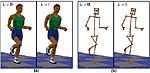
Fig. 1. Images of an animated human runner. (a) Two
running motions rendered using a polygonal model. (b) The same pair of motions
are rendered with a stick figure model. Modifications to the motion were
controlled by a normalized parameter, ![[lgr]](phmdgm_files/lgr.gif) , that varied between = 0 and = 1. These images are from the motion generated
for the additive noise test discussed in Section 3.3. The difference in
posture created by the additive noise can be seen in the increased angle of
the neck and waist in the right image of each pair ( = 1).
, that varied between = 0 and = 1. These images are from the motion generated
for the additive noise test discussed in Section 3.3. The difference in
posture created by the additive noise can be seen in the increased angle of
the neck and waist in the right image of each pair ( = 1).
2. BACKGROUND
Several researchers have used light-dot displays, also referred to as
biological motion stimuli, to study perception of human movements and to
investigate the possibility of dynamic mental models [21]. The light-dot displays show only
dots or patches of light that move with the main joints of walking figures (Fig. 2), but even these minimal cues
have been shown to be sufficient for viewers to make detailed assessments of
the nature of both the motion and the underlying figure.
.gif)
Fig. 2. (a) The joint locations of a human runner at a
single point in time. (b) The joint locations over the course of one step in
the running cycle. Although it is difficult to determine the nature of these
patterns from a still image, studies show that most people are able to
recognize the motion and even to make fine judgments when shown moving
sequences of similar images.
The ability to perceive human gaits
from light-dot displays has been widely reported to be acute and robust. Early
experiments by Johansson reported that 10-12 light dots "evoke a compelling
impression of human walking, running, dancing, etc." [1]. Because such displays provide
motion cues independent of form or outline, other investigators have used them
to study human motion perception. Work by Cutting and Kozlowski showed that
viewers easily recognized friends by their walking gaits on light-dot displays
[2]. They also reported that the gender
of unfamiliar walkers was readily identifiable, even after the number of
lights had been reduced to just two located on the ankles [3]. In a published note, they later
explained that the two light-dot decisions were probably attributable to
stride length [4]. Continuing this work, Barclay et
al. showed that gender recognition based on walking gait required between 1.6
and 2.7 seconds of display, or about two step cycles [22]. Our experiments used pairs of
running stimuli 4 seconds in duration that displayed about six strides. We
noticed that test subjects often marked their answer sheets near the midpoint
of the second stimuli, which is consistent with Barclay's results.
Motion is apparently essential for
identifying human figures on light-dot displays. The Cutting studies reported
that, while moving light-dot displays were recognized immediately, still
light-dot displays of a walking figure were not recognized as human. Poizner
et al. also noted that movement is required for accurately reading American
Sign Language gestures [

